“In the last few years, the role of the writer has changed. It’s no longer something you get around to doing when things are a bit quieter, it’s not enough to write a book and send it off to a publisher. You are required to play a complicated game with the media that involves a lot of planning and projections, because the ground is shifting. Publishers do a lot of things for me, but the thing they do most these days is apologise. ‘We can’t', ‘we wish’, ‘it’s not cost effective’, ‘it’s an uncertain climate.’ That’s fine, they try to help get me published and it’s all you can hope for. In England there was a long tradition of the Actor-Manager, and now there are Writer-Managers, but here’s the thing – the more a good writer does that isn’t actually writing, the worse s/he gets.”
2/17/10
Following Christopher Fowler ... through peculiar times ...
Christopher Fowler is a favorite crime writer of mine. His “Peculiar Crimes Unit” series, now relabeled “Bryant & May” is blend of great characters, tight plots, and lots of tidbits of London history.
“In the last few years, the role of the writer has changed. It’s no longer something you get around to doing when things are a bit quieter, it’s not enough to write a book and send it off to a publisher. You are required to play a complicated game with the media that involves a lot of planning and projections, because the ground is shifting. Publishers do a lot of things for me, but the thing they do most these days is apologise. ‘We can’t', ‘we wish’, ‘it’s not cost effective’, ‘it’s an uncertain climate.’ That’s fine, they try to help get me published and it’s all you can hope for. In England there was a long tradition of the Actor-Manager, and now there are Writer-Managers, but here’s the thing – the more a good writer does that isn’t actually writing, the worse s/he gets.”
2/16/10
And the Toller Cranston award ...
goes to Johnny Weir. About Toller, an Olympian skater favorite from way back. Canadians will remember.
A good day for a Roger Ebert quote ...
“Almost the first day I started writing reviews, I found a sentence in a book by Robert Warshow that I pinned on the wall above my desk. I have quoted it so frequently that some readers must be weary of it, but it helps me stay grounded. It says:
“A man goes to the movies. A critic must be honest enough to admit he is that man.
“That doesn't make one person right and another wrong. All it means is that you know how they really felt, not how they thought they should feel.”
“The Best Films of the Decade“
“A man goes to the movies. A critic must be honest enough to admit he is that man.
“That doesn't make one person right and another wrong. All it means is that you know how they really felt, not how they thought they should feel.”
“The Best Films of the Decade“
2/15/10
Post once, publish everywhere ...
I mess around with the various publishing platforms available. You can take the editor out of publishing, but you can’t ...
The newest publishing platform this week is Google’s Buzz. It could be a dilly. It links in nicely to my micro publishing flow:
* I like to keep my content on my computer, not residing on the web. So I use a journaling app, MacJournal, to create a post, which I upload to my blog.
* I like to use images often, so I make a blog app, Blogger, my primary online posting site.
* When I post to my blog, snitsbits, the header and blog link are automatically reposted to Twitter.
* From Twitter, the same info is reposted automatically to Facebook, Linkedin, and now Buzz.
The flow goes from Twitter to the rest because not all these kids want to play together; Twitter won’t currently receive posts from Buzz, for instance. And Buzz doesn’t want to post to Twitter because Twitter only handles a line or two of text, not pics. Who cares? This works for me.
The newest publishing platform this week is Google’s Buzz. It could be a dilly. It links in nicely to my micro publishing flow:
* I like to keep my content on my computer, not residing on the web. So I use a journaling app, MacJournal, to create a post, which I upload to my blog.
* I like to use images often, so I make a blog app, Blogger, my primary online posting site.
* When I post to my blog, snitsbits, the header and blog link are automatically reposted to Twitter.
* From Twitter, the same info is reposted automatically to Facebook, Linkedin, and now Buzz.
The flow goes from Twitter to the rest because not all these kids want to play together; Twitter won’t currently receive posts from Buzz, for instance. And Buzz doesn’t want to post to Twitter because Twitter only handles a line or two of text, not pics. Who cares? This works for me.
2/13/10
Posting a travel tip ...
Useful airfare search site, includes a 30 day chart showing fares around the timetable you input, as well as senior fare options. You send the results to your local travel agency to generate the tickets, so that’s good citizenry. Add a bit to the listed prices for tax and fees.
2/11/10
Practicing for Dussy ...
One of the most enjoyable aspects of visiting Chris in Düsseldorf is cooking for the clan in his apartment house. Here’s a gorgonzola pizza using a biscuit crust, the crust idea compliments of Basil’s, a restaurant in Northfield, MN, we supped at when the boys were in college at St. Olaf long ago. And of course it’s on the web today.
Thinking about the Times ... and Mores ...
Today the New York Times made its historical archives available to subscribers. Nice. Here’s the front page for March 5, 1861, the first of Lincoln’s inaugurations. Probably not readable here. The inset is the text of the article. Nice again. The NYT is making a push to secure paid subscriptions by leveraging several new services. My best wishes.
Speaking of best wishes: The term inauguration* caught my eye. It’s that extra “u.” I’m presently reading a historical novel about Cicero, Conspirata, in which the auguries are part of the political rituals of transition.
*ORIGIN late 16th cent.: from Latin inaugurat- ‘interpreted as omens (from the flight of birds),’ based on augurare ‘to augur.’
SOURCE: New Oxford Dictionary
Speaking of best wishes: The term inauguration* caught my eye. It’s that extra “u.” I’m presently reading a historical novel about Cicero, Conspirata, in which the auguries are part of the political rituals of transition.
*ORIGIN late 16th cent.: from Latin inaugurat- ‘interpreted as omens (from the flight of birds),’ based on augurare ‘to augur.’
SOURCE: New Oxford Dictionary
2/10/10
Move over Twitter ... What's the Buzz?
Google is offering an alternative to Twitter and Facebook both, called Buzz. This is the “phone” version of the web app. It’s mighty purty. In fact, looking at the desktop and phone versions, it’s been built for mobile use primarily.
Image at 3x. Don’t I wish the screen was this size. Hmm.
2/6/10
Reading a great Cory Doctorow quote on the Kindle ...
Doctorow is a crusader against digital rights management. This comment sums what bugs me about all ebook readers as well:
“Presumably, Amazon perceives the $10 price-tag as a way of encouraging people to buy its Kindle platform, which itself is a kind of roach-motel for books: the license terms and DRM on the books in the Kindle store prohibit you from reading your Kindle books on competing devices. So books check in, but they don't check out.”
1/31/10
Probably projecting from my past ...
Post-iPod, Apple looks to huge content areas to run through its hardware. With the just announced iPad, there is a confluence of content that Apple has already secured: music, apps. But Steve Jobs knows that new hardware must be matched and mated to new gigantic, coherent content sectors. The last slide in his presentation (below) says it all: Steve is going after education as a market. The whole enchilada of educational publishing.
The hardware is spot on: Simple, safe, small, light, cheap (or soon will be) exactly right for students from grade school to grad school. The software provides the creativity/research tools students need. The iWork apps are astonishingly lovely, creative, and fun software.
It will not mean all printed books be damned but it will mean printed textbooks be damned. Maybe it will be textbooks be damned: I’m guessing it’s the creativity tools that Steve really cares about. Ten years out, every student will have an iPad or something just like it. Finally. Except Apple will be there first and foremost. That’s a done deal as of last Wednesday.
Everything about the iPad says that Steve Jobs wants to be remembered as the guy who revolutionized schooling if not learning. Take a look at the mission at the OLPC site. That’s Jobs’s kind of language and vision, except he not only thinks bigger than most of us, he thinks better.
SOURCE: Apple Inc.
The hardware is spot on: Simple, safe, small, light, cheap (or soon will be) exactly right for students from grade school to grad school. The software provides the creativity/research tools students need. The iWork apps are astonishingly lovely, creative, and fun software.
It will not mean all printed books be damned but it will mean printed textbooks be damned. Maybe it will be textbooks be damned: I’m guessing it’s the creativity tools that Steve really cares about. Ten years out, every student will have an iPad or something just like it. Finally. Except Apple will be there first and foremost. That’s a done deal as of last Wednesday.
Everything about the iPad says that Steve Jobs wants to be remembered as the guy who revolutionized schooling if not learning. Take a look at the mission at the OLPC site. That’s Jobs’s kind of language and vision, except he not only thinks bigger than most of us, he thinks better.
1/30/10
Nagel kids circa 1980 ...
On the event of Gen and Chris’s birthdays this month. This photo hangs in our livingroom. It’s fading fast. I scanned it into photoshop to see what I can save.
1/28/10
Looking at the iPad applications ...
What it took to bring the word processing, spreadsheet, and presentation apps from the Mac OS to the iOS is an effort not to be sneezed at. What doing means is the shift to multitouch based apps on all the Apple products. Spectacular.
SOURCE: Apple Inc.
SOURCE: Apple Inc.
Looking at the Apple iPad again ...
If my previous note sounds critical, I’m not. I’m a huge Apple fan. I love how it thinks things through as a consumer electronics company. (Apple took the word “computer” off its name a couple years ago.)
Here’s an example: One of the shifts from computers as geek tools to computers as “the rest of us” tools/toys has to do with designing computers that are more sociable. Take the notebook. Sure, we can bring it with us. But as soon as we set it up, it puts a big screen between us and those sitting across from us. In coffee shops, notebookers sit alone and not always by choice. The notebook says “I’m here to work or at least look like I’m working while I websurf. Don’t sit down.” No longer: see how the cool case with the iPad folds so that it can sit on a table and allow for a flow of conversation? Nicely done.
Of course, there is the problem, insinuated here, that some notebookers will begin yakking about Star Trek when you do sit down. Apple hasn’t yet found a content provider for our downloading bits of chat relevant to the interests of the person across from us. Maybe some day. At least now you can see what interests them. If upside down.
SOURCE: Apple Inc.
Here’s an example: One of the shifts from computers as geek tools to computers as “the rest of us” tools/toys has to do with designing computers that are more sociable. Take the notebook. Sure, we can bring it with us. But as soon as we set it up, it puts a big screen between us and those sitting across from us. In coffee shops, notebookers sit alone and not always by choice. The notebook says “I’m here to work or at least look like I’m working while I websurf. Don’t sit down.” No longer: see how the cool case with the iPad folds so that it can sit on a table and allow for a flow of conversation? Nicely done.
Of course, there is the problem, insinuated here, that some notebookers will begin yakking about Star Trek when you do sit down. Apple hasn’t yet found a content provider for our downloading bits of chat relevant to the interests of the person across from us. Maybe some day. At least now you can see what interests them. If upside down.
SOURCE: Apple Inc.
Looking at the Apple iPad ...
I hear it’s a very fast, and obviously fun, user interface. UI is Apple’s bag and it’s putting down a big bet on shiny, speedy computing. Not a bad price, and in a year this device may be under $400 for an iPod with real Mac apps like Pages and Numbers; like the iPods it requires a Mac/PC as a mothership. (Hmm, so that’s why they call them ‘pods.) Looking at the photo below this morning, I’m wishing Apple chose a smaller, Kindle, book sized screen on the principle that the only good computer is the one I have with me. Throw in the docking keyboard and a camera and I’d be good. I guess that Apple doesn’t want us to take this mobile Mac any further than the couch. [Updated 4PM]
Deconstructing this model name, the ‘pad refers to the weight we can gain sitting around using it. Or perhaps it’s an Apple credal statement: I pad, as in, I can be found at my place using this gizmo anytime.

SOURCE: Gizmodo

SOURCE: Apple Inc.
Deconstructing this model name, the ‘pad refers to the weight we can gain sitting around using it. Or perhaps it’s an Apple credal statement: I pad, as in, I can be found at my place using this gizmo anytime.
SOURCE: Gizmodo
SOURCE: Apple Inc.
1/27/10
Following up on photo location services ...
Yesterday I mentioned posting shots to Panoramio and its location recognition service, partly dependent on location information. Following up, I picked up a memory card for my camera that has GPS location software built in, which means my camera will be good to go for years yet. So it’s cheap at the price. Also, when I put the camera near my computer, the card wirelessly and automatically uploads the shots. Nice.
1/26/10
Following Google down scenic pathways ...
I hope you can see this well enough. Below a photo I have on Google’s Panoramio site I found a link called “Look around.“ It brings up shots of the same scene and indicates how your photo fits the scene relative to the others. Wow.
The end of editing as we know it ...
Thanks, Hannah! And Happy Birthday!
fi yuo cna raed tihs, yuo hvae a sgtrane mnid too. Cna yuo raed tihs? Olny 55 plepoe out of 100 can.i cdnuolt blveiee taht I cluod aulaclty uesdnatnrd waht I was rdanieg. The phaonmneal pweor of the hmuan mnid, aoccdrnig to a rscheearch at Cmabrigde Uinervtisy, it dseno't mtaetr in waht oerdr the ltteres in a wrod are, the olny iproamtnt tihng is taht the frsit and lsat ltteer be in the rghit pclae. The rset can be a taotl mses and you can sitll raed it whotuit a pboerlm. Tihs is bcuseae the huamn mnid deos not raed ervey lteter by istlef, but the wrod as a wlohe. Azanmig huh? yaeh and I awlyas tghuhot slpeling was ipmorantt! if you can raed tihs forwrad it.
Taking stock of Apple ...
I have tracked Apple as a company since the eighties, when I really did need to know what publishing technologies to adopt for use at work. Apple’s certainly had its ups and downs. What I see in the chart below is not how Apple is doing specifically but where the computer to going: The computer olympics are warming up. So it’s all about computers becoming faster, smaller, lighter, thinner, brighter, and cheaper. All computers are becoming “computers for the rest of us.” The first Apple computer I bought in 1987 was $2,800; the Apple computer I carry with me cost $200 last year and has more than 100 times the memory and speed.
SOURCE: Google Finance
1/25/10
1/13/10
Watching sun, shadow, and snow on the Mississippi River ...
I brought a new camera out to the boathouse, one I gave Barb. It’s a tiny marvel.
Here’s a link to a larger version.
Here’s a map of Winona, Minnesota, with the boathouse location marked in red.
Here’s a link to a larger version.
Here’s a map of Winona, Minnesota, with the boathouse location marked in red.
1/3/10
How Twain ruined Melville for me ... and a good thing it is ...
I mentioned that I recently read Melville’s Moby-Dick. I didn’t mention how I was put off by the overwrought writing, characters, and speeches. Listening to a program on Mark Twain I heard the reason for this completely and abruptly stated: “Huckleberry is not Ahab.” For sure. The use of accessible common speech that we enjoy in literature today was apparently a gift from Twain, one that was not understood or accepted immediately. Below is an excerpt from a newspaper article regarding the publication of The Adventures of Huckleberry Finn:
“The Concord (Mass.) Public Library committee has decided to exclude Mark Twain's latest book from the library. One member of the committee says that, while he does not wish to call it immoral, he thinks it contains but little humor, and that of a very coarse type. He regards it as the veriest trash. The library and the other members of the committee entertain similar views, characterizing it as rough, coarse, and inelegant, dealing with a series of experiences not elevating, the whole book being more suited to the slums than to intelligent, respectable people.” Wikipedia
1/1/10
My top ten love story films ...
Listing these moved my thinking from the typical to edgier films, from traditional guy/gal stories to father/son relationships, and on to Brokeback Mountain. And there are twelve films listed in no particular order. The listed names are the “active ingredients” of the films—the actors, writers, directors, and places that made a particular film work for me. May be updated and reposted.
Bread and Tulips (Bruno Ganz, Licia Maglietta, and Venice)
Notting Hill (Hugh Grant, Roger Michell, and Richard Curtis)
Life is Beautiful (Roberto Benigni)
Ordinary People (Donald Sutherland and Mary Tyler Moore)
Educating Rita (Michael Caine and Julie Walters)
Moonstruck (Cher, Nick Cage, and Olympia Dukakis)
Four Weddings and a Funeral (more Hugh and more Richard Curtis)
Persuasion (Ciarán Hinds and more Roger Michell)
About a Boy (even more Hugh and Nick Hornby)
Stage Beauty (Billy Crudup and Claire Danes)
Casanova (Heath Ledger, Sienna Miller, and more Venice)
Brokeback Mountain (more Heath Ledger and Jake Gyllenhaal)
Bread and Tulips (Bruno Ganz, Licia Maglietta, and Venice)
Notting Hill (Hugh Grant, Roger Michell, and Richard Curtis)
Life is Beautiful (Roberto Benigni)
Ordinary People (Donald Sutherland and Mary Tyler Moore)
Educating Rita (Michael Caine and Julie Walters)
Moonstruck (Cher, Nick Cage, and Olympia Dukakis)
Four Weddings and a Funeral (more Hugh and more Richard Curtis)
Persuasion (Ciarán Hinds and more Roger Michell)
About a Boy (even more Hugh and Nick Hornby)
Stage Beauty (Billy Crudup and Claire Danes)
Casanova (Heath Ledger, Sienna Miller, and more Venice)
Brokeback Mountain (more Heath Ledger and Jake Gyllenhaal)
12/27/09
Page 1 news ... BBC weds iTunes ...
Here’s a first update on what’s on page 1 of my iPod Touch (photo left). With over 100K of apps available and 435 currently in my library on my computer, choosing which little programs to keep on the iPod Touch and then giving just 20 apps page 1 status is an interesting, if microscopic, question of personal and social perceptions. (And what’s a blog for if not microscopic personal perceptions?) Today’s new entry is the NPR News app (photo right), which can be used to read the well written stories, listen to them live, and create a playlist for later listening while working or walking. A great app design combines high function and form, both serving the purposes of great content. This one has it all.
12/26/09
Add a touch of hot sesame oil and this is a winner ...
A nice way to use the leftover fish, and rice, from yesterday’s dinner: Asian salmon and rice soup.
12/20/09
Stollen, Barb style ...
With thanks to Gen and Naren for hosting a terrific holiday gathering! Ah, yes, and that’s a fabulous lebkuchen cake Gen whipped up in the upper left.

12/18/09
Reflecting on a great graphic ... and a losing campaign ...
Not my time of year I guess. Watching the health care reform peter away yesterday reminded me of an informational visual by Charles Minard, celebrated by Edward Tufte, depicting Napolean’s retreat from Russia, plotted against the temperature.
Link to larger image.
One good graphic leads to another ...
Last year The Economist listed the graphic below, along the one by Minard, now above, as one of the best three graphics created. Interestingly it’s by Florence Nightingale. Quite modern in look. And coincidentally I finished an Anne Perry novel about a Nightingale nurse just yesterday. Nightingale’s graphic depicts the seasonal frequency and causes of death of soldiers in the Crimean War at her hospital.
12/17/09
My top ten crime novelists this year and any year ...
A friend asked for some recommendations yesterday. So here’re my all time favorites, listed lightest to darkest as to their tonality, with one book title for reference purposes. Maybe later I will annotate this list. Do start with Camilleri: His are lovely little books, wonderfully written and translated.
Andrea Camilleri (Sartarelli), The Terracotta Dog
Christopher Fowler, The Water Room
David Liss, The Coffee Trader
C. J. Samson, Revelation
Michael Dibdin, Blood Rain
Vikram Chandra, Sacred Games
Michael Robotham, Suspect
Peter Høeg, Smilla’s Sense of Snow
Martin Cruz Smith, Gorky Park
Tom Rob Smith, Child 44
Andrea Camilleri (Sartarelli), The Terracotta Dog
Christopher Fowler, The Water Room
David Liss, The Coffee Trader
C. J. Samson, Revelation
Michael Dibdin, Blood Rain
Vikram Chandra, Sacred Games
Michael Robotham, Suspect
Peter Høeg, Smilla’s Sense of Snow
Martin Cruz Smith, Gorky Park
Tom Rob Smith, Child 44
12/14/09
Finding what's beautiful as we approach the shortest days of the year ...
Gran Torino has that elegiac beauty consonant with the season. Over his career Clint has moved from representing the most naive heroes in American film to some wonderful attempts to see our heroes as fallen folk who enter heaven a dog’s breath before the gate closes.
If there were no such thing as calories, wouldn't we eat donuts everyday? ...
As it is, we make them just for Hanukkah. And then just the holes.
12/13/09
Listening to a Neil Sheehan interview ...
Years ago I sat next to Neil Sheehan on a flight to DC. Ashamed to say, he expressed more interested in my work than I did in his. Very nice guy. Here’s an interview on his new book.
12/11/09
Coffee ... the healthy drink ...
“Coffee not only perks up energy and helps sharpen the mind, it has been shown to lessen the severity of a heart attack or stroke and protect against certain cancers, type 2 diabetes, liver disease and gallstones. There’s also evidence that coffee may help stop a headache, boost mood and even prevent cavities. And a study presented this week at the Frontiers in Cancer Prevention Research conference in Houston, Texas shows that men who drink coffee on a regular basis have an added benefit—a significantly decreased risk of developing aggressive prostate cancer....The men who drank the most coffee (six or more cups per day) were nearly 60 percent less likely to develop advanced prostate cancer and 19 percent less likely to develop any form of prostate cancer than men who drank no coffee.” SOURCE
I interpret this to mean I have 120% less chance of any illness whatsoever.
12/5/09
A well-named entertainer ...
12/2/09
Let me see, what are we paying for cellphone use? ...
Today I received a video/audio feed from Chris in Germany on my iPod Touch. Free app. Free feed using wifi. My Touch does not have a camera, so Chris receives audio only. But it’s rumored that Apple will put a camera in the iPod Touch next year. I’m guessing the telcos are threatening/pleading with Apple not to do this. Eh?

12/1/09
Tracking the wild beeb ...
It’s a beautiful thing: podcasting. Radio when and where you want it. I track perhaps fifty programs; I listen to maybe ten regularly; the others I watch to see if the topics catch my interest.
Of these, the BBC programs are the most valuable. The BBC is to consumer content what Apple is to consumer tech: everyone else should just stand back and let it handle the whole thing. Among its audio programs, Andrew Marr’s Start of the Week is the one that I never miss and most relish. Now, if the BBC would only let us, as in US, subscribe.
11/28/09
11/25/09
11/24/09
Post transaction scammers
I don’t use this blog for rants; I prefer to do that in comments section right next the writer’s piece. But this online retailer scam is breathtaking in its breadth and audacity. Here’s the short of it and links to the article and the congressional information.
Article summary and link:
“Ever wonder if those last-minute offers on e-commerce sites for coupons and savings are actually legitimate? According to the Senate Commerce Committee, they are actually coordinated efforts to dupe consumers – to the tune of $1.4 billion.
“The committee on Tuesday released a report that slammed online marketing companies Affinion, Vertrue, and Webloyalty for selling unfamiliar membership programs to consumers who are in the process of buying products on trusted Web sites.
“Entering the e-mail address actually signs consumers up for membership programs through companies like Affinion, Vertrue, and Webloyalty, but many consumers do not read the fine print that explains this arrangement. Credit card information is pulled from the original purchase page. [Emphasis added!] Most do not know they have agreed to these services until the monthly charges show up on their credit card statements; most between $10 and $20.”
Congressional report key finding and link:
*Using aggressive sales tactics to enroll consumers in unwanted membership clubs is a billion-dollar business. Affinion, Vertrue, Webloyalty and their e-commerce partners have earned over $1.4 billion in revenue by using aggressive tactics to charge Internet shoppers for club membership programs. Since 1999, Internet consumers have been enrolled more than 35 million times in Affinion, Vertrue, and Webloyalty‘s membership clubs. In June 2009, there were 4 million Internet consumers currently enrolled in these three companies‘ membership programs.“
Partners Paid Over $10 Million (and link):
1-800-Flowers.com
Buy.com
Classmates.com
Columbia House
Confi-Check
Expedia/Hotels.com
Fandango FTD
Hotwire
InQ Intelius
MovieTickets.com
Orbitz
Priceline
Redcats USA
Shutterfly
Travelocity
US Airways
VistaPrint
Article summary and link:
“Ever wonder if those last-minute offers on e-commerce sites for coupons and savings are actually legitimate? According to the Senate Commerce Committee, they are actually coordinated efforts to dupe consumers – to the tune of $1.4 billion.
“The committee on Tuesday released a report that slammed online marketing companies Affinion, Vertrue, and Webloyalty for selling unfamiliar membership programs to consumers who are in the process of buying products on trusted Web sites.
“Entering the e-mail address actually signs consumers up for membership programs through companies like Affinion, Vertrue, and Webloyalty, but many consumers do not read the fine print that explains this arrangement. Credit card information is pulled from the original purchase page. [Emphasis added!] Most do not know they have agreed to these services until the monthly charges show up on their credit card statements; most between $10 and $20.”
Congressional report key finding and link:
*Using aggressive sales tactics to enroll consumers in unwanted membership clubs is a billion-dollar business. Affinion, Vertrue, Webloyalty and their e-commerce partners have earned over $1.4 billion in revenue by using aggressive tactics to charge Internet shoppers for club membership programs. Since 1999, Internet consumers have been enrolled more than 35 million times in Affinion, Vertrue, and Webloyalty‘s membership clubs. In June 2009, there were 4 million Internet consumers currently enrolled in these three companies‘ membership programs.“
Partners Paid Over $10 Million (and link):
1-800-Flowers.com
Buy.com
Classmates.com
Columbia House
Confi-Check
Expedia/Hotels.com
Fandango FTD
Hotwire
InQ Intelius
MovieTickets.com
Orbitz
Priceline
Redcats USA
Shutterfly
Travelocity
US Airways
VistaPrint
11/23/09
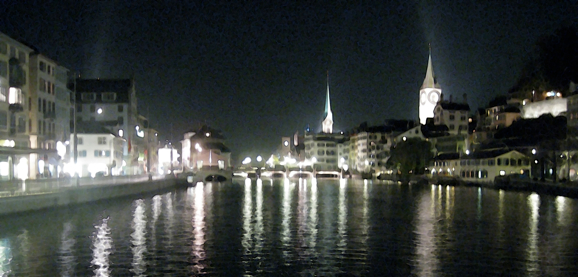
Saving a shot from Zurich, at night ...
Photoshop filters are great. But then the height of my photographical ambition is a great postcard.
11/22/09
Why Google's work is interesting and useful ...
My grandfather shows up in a Google search in a Google-digitized book on the Chicago Medical Society.
Why I froth on about Bryant and May ...
Christopher Fowler’s series about two aging London detectives is a treat to read, or listen to as I do. Much fun in Fowler’s knowledge of the city. I have high hopes of seeing Connery and Caine reprise their Man Who Would Be King film partnership playing these guys. From Fowler’s blog:
“Whenever I do a signing in a bookstore, there’s always someone in the queue who will say something like ‘Did you know there’s a statue of Mercury hidden on top of a fish shop near here?’ And I’ll set out to find it, and discover why it’s there. London’s peculiarities are peppered through all my books, and the most unbelievable parts of the stories are often the truest. I make up very little of the background material.”
11/16/09
Acquiring November light 5 ...
at Perrot State Park
11/15/09
11/12/09
11/9/09
Ex opere ...
Not sure how this came up last night.
Ex opere operato: From the work that is done. A term defined by the Council of Trent to describe how the sacraments confer the grace they signify. Trent condemned the following proposition: "That grace is not conferred 'ex opere operato' by the sacraments of the New Law" (Denzinger 1608). Literally the expression means "from the work performed," stating that grace is always conferred by a sacrament, in virtue of the rite performed and not as a mere sign that grace has already been given, or that the sacrament stimulates the faith of the recipient and thus occasions the obtaining of grace, or that what determines the grace is the virtue of either the minister or recipient of a sacrament. Provided no obstacle (obex) is placed in the way, every sacrament properly administered confers the grace intended by the sacrament. In a true sense the sacraments are instrumental causes of grace.
Ex opere operantis: From the work as it is done (by the worker). A term mainly applied to the good dispositions with which a sacrament is received, to distinguish it from the ex opere operato, which is the built-in efficacy of a sacrament properly conferred. But it may refer to any subjective factor that at least partially determines the amount of grace obtained by a person who performs some act of piety. Thus in the use of sacramentals or in the gaining of indulgences, the blessings received depend largely on the faith and love of God with which a sacramental is employed or an indulgenced prayer or good work is performed.
Ex opere operato: From the work that is done. A term defined by the Council of Trent to describe how the sacraments confer the grace they signify. Trent condemned the following proposition: "That grace is not conferred 'ex opere operato' by the sacraments of the New Law" (Denzinger 1608). Literally the expression means "from the work performed," stating that grace is always conferred by a sacrament, in virtue of the rite performed and not as a mere sign that grace has already been given, or that the sacrament stimulates the faith of the recipient and thus occasions the obtaining of grace, or that what determines the grace is the virtue of either the minister or recipient of a sacrament. Provided no obstacle (obex) is placed in the way, every sacrament properly administered confers the grace intended by the sacrament. In a true sense the sacraments are instrumental causes of grace.
Ex opere operantis: From the work as it is done (by the worker). A term mainly applied to the good dispositions with which a sacrament is received, to distinguish it from the ex opere operato, which is the built-in efficacy of a sacrament properly conferred. But it may refer to any subjective factor that at least partially determines the amount of grace obtained by a person who performs some act of piety. Thus in the use of sacramentals or in the gaining of indulgences, the blessings received depend largely on the faith and love of God with which a sacramental is employed or an indulgenced prayer or good work is performed.
Acquiring November light ...
from Whitewater State Park
11/6/09
"Regulation can never cure the disease of excessive risk."
Great quote in a helpful interview. Not that I don’t believe in regulation.
“You also can’t excuse Alan Greenspan for handing out free money to Wall Street every time the big firms screwed up over the past thirty years. It gave them incentive to double down on their risky bets until of course they double-downed so much the system blew up.” Charlie Gasparino
11/5/09
Gloucester fishing in the day of sail
My grandfather James Campbell fished out of Gloucester and Boston during the 1880s and 1890s, according to my cousins Jim Campbell and Father Louis, family memoirist. I found the photo below in Joseph E. Garland’s Gloucester on the Wind, credited to photographer Martha Rodgers Harvey, from this collection of photos of Gloucester’s fishing fleet in the days of sail. Compare with the painting by Winslow Homer, Gloucester Schooners and Sloop, dated about 1880.
Note from the revolution: ebook readers and applications
So, as noted yesterday, I need to revise the matrix on ebook readers. This gives me a chance to rave and rant briefly.
* On the rave side, in this revision, Stanza wins. And it is a winner. Try it on your ‘puter if you don’t own a ‘pod. Stanza’s ability to convert web documents into ebooks, with its bookmarking and annotation tools, is big. Bigger yet is Stanza’s lack of DRM, digital rights management, limits, which I scored heavily. Others might disagree with this weighting.
* Which leads to my rant about DRM. It’s simple: If I can’t sell a tune, book, film, app, whatever that I have purchased, then I don’t own it in the first place; I am merely leasing its use. So all the DRM types out there are, for me, categorically wrong headed. This is particularly true of books, which we are used to giving, lending, donating, and reselling as part of any given book’s life cycle. Resale of property is an inherent trait of ownership. Those media vendors that mess with that piece will not succeed finally. On the other hand, the first place (my guess is Amazon but why not eBay?), that lets me resell my s. And make a pile of geld.
* On the rave side, in this revision, Stanza wins. And it is a winner. Try it on your ‘puter if you don’t own a ‘pod. Stanza’s ability to convert web documents into ebooks, with its bookmarking and annotation tools, is big. Bigger yet is Stanza’s lack of DRM, digital rights management, limits, which I scored heavily. Others might disagree with this weighting.
* Which leads to my rant about DRM. It’s simple: If I can’t sell a tune, book, film, app, whatever that I have purchased, then I don’t own it in the first place; I am merely leasing its use. So all the DRM types out there are, for me, categorically wrong headed. This is particularly true of books, which we are used to giving, lending, donating, and reselling as part of any given book’s life cycle. Resale of property is an inherent trait of ownership. Those media vendors that mess with that piece will not succeed finally. On the other hand, the first place (my guess is Amazon but why not eBay?), that lets me resell my s. And make a pile of geld.
11/4/09
Note from the revolution ...
Today I revised and reposted a chart analyzing the current generation of ebook readers. Stanza, mentioned, is not a reader but an application for use on a ‘puter or ‘pod. Unnoted in my analysis is a terrific feature, whereby Stanza will pull in text from a website and recreate it as an ebook for use on ‘puter, ‘pod, or kindle. I have sized the screen shot below to my ‘pod. Note that the font size can be enlarged; this shot displays my preference. Anyway it’s a deal-maker ingredient for any ebook reader or app. (That said. I have to revise the chart again.)
Fontainebleau Forest with friends ...
We had a fine walk with Ruth Anne and Paddy on our visit to Féricy. My shot didn’t do it justice. See Claude Monet’s The Bodmer Oak, Fontainebleau Forest, 1865.
Lead like the great conductors ...
Jim Campbell published this link to a Ted Talk on Facebook.
“An orchestra conductor faces the ultimate leadership challenge: creating perfect harmony without saying a word. In this charming talk, Itay Talgam demonstrates the unique styles of six great 20th-century conductors, illustrating crucial lessons for all leaders.”
More on ebook reading devices and programs ...
Well the revolution is here. Maybe four ebook reading devices were announced in the last week. I think they are all trying to get positioned before the Apple Slate shows up in the spring. Here’s a revision of my analysis sheet. It’s not comprehensive; it includes the main contenders.
11/2/09
10/31/09
Home on the alpen range ...
On a brief stay in Zurich, I went looking for the relics of the Reformation. I think I saw echoes of the movement in the architecture. Solid, plain, rock of ages stuff. How big a leap is it, do you think, to the stolid, drab, breaking big rocks into little rocks architecture of the communist countries?
Subscribe to:
Posts (Atom)